I’m sure this post comes as no surprise to those that have followed us thus far. Food is one of our biggest passions so we will be keeping this up as we go along. In our third moon we had the pleasure of eating our way through Morocco. The staples in Morocco are things made from dough (bread, flat bread, various types of pancake like things, etc), olives, dates and dried fruit, couscous, tajine (made from root vegetables and various meats excluding pork), La Vache Qui Rit and Kiri cheese, argan oil and let’s not forget mint tea. Mint tea is the cornerstone of Moroccan society: it is not just a beverage it’s a way of life in Morocco. It ends every meal and all socializing and business is conducted over mint tea. The service itself is a ceremony. The tea arrives in small metal pot filled with fresh mint and hot water accompanied by a large block of sugar. Before you drink the tea the host will take most of the sugar and crumble it into the pot. Then the ceremonial pouring and repouring of the tea begins. The tea is poured into one of the small glass glasses and this is not just any pour, the pot is tilted and is gradually raised above the glass to a couple of feet as the liquid slowly fills the glass. The liquid is then poured back into the metal pot. Seeing the pride in the eyes of the pourer as they go higher and higher with the pot is absolutely pricess. These two steps are repeated quite a few times before the tea is finally poured for drinking. The end result is a very sweet warm minty beverage.
Super greasy and super tasty breakfast
Next is breakfast. Breakfast on the go Moroccan style almost always involves either a Moroccan pancake or a deep fried dough. A Moroccan pancake or ‘Rghaif’ is a flaky yet dense dough which when fried resembles something like a flattened croissant - pancake hybrid. You can have it plain or as we saw it, with argan oil and/or honey in the south, or with cheese and honey in the north. All absolutely delicious. There is also a much larger version which we think is called a ‘Beghrir’. The super greasy deep fried dough that is the heavier deadlier breakfast can be had with or without an egg fried into it. Let us describe the cooking process with an egg: first the man grabs a ball of dough and flattens it into a hockey puck, this puck is dropped in a huge tub of sizzling cooking oil. After two minutes of bathing in the oil the man grabs the sizzling fried dough with his bare hands rips a hole in the middle, throws it back into the oil and cracks an egg into the hole. After a single flip and about a minute of cooking time the finished product is placed on a single napkin for consumption. Oh God is this greasy heart attack ever worth it. We suggest washing it down with a cup of coffee followed by a bath. In contrast to this street fare, a typical hotel breakfast pretty much always consists of bread, jam, butter, orange juice and coffee. We also had the pleasure of having breakfast with a Berber family in their home. The menu consisted of a Berber porridge (rice, millet and lots of milk), home made Moroccan bread, jam, honey, argan oil and of course mint tea.
Hotel Atlas' tajine kefta kiri (just finger licking good)
Lunch and dinner are pretty much the same, with lunch seeming to be the larger meal. At restaurants, meal. At restaurants, meal. At restaurants, the meal always starts with bread, butter and spiced olives. In the western restaurants and hotels you always get cutlery however Moroccans use the bread as their utensils and always eat only with their right hand. The main course usually consists of some form of a tajine, kebabs or couscous. Quality and flavor certainly depended on the cook. We had some great food and some pretty bland food. So what is a Tajine you ask? Tajine is a Moroccan stew cooked in a conical earthenware pot that keeps the juices in and the meat tender and moist. They come in all shapes and sizes from a basic vegetable tajine to a meat tajine with vegetables and/or olives and/or lemons and/or cheese. While we are on the topic of tajines we have to say that the best one we had all trip was the tajine kefta kiri at hotel Atlas in Mirleft cooked by the Kadija. This a tajine made with meatballs in a rich tomato sauce with kiri cheese and toped with a sizzling egg. A tajine masterpiece. We hope to have this again… inshallah. The bread that comes with all the meals as a side or utensil is called Khoobz. It’s a Moroccan style pita bread that’s about an inch thick, crusty on the outside and fluffy on the inside.
Snack options in Morocco are the above mentioned pita breads cut in half and stuffed with minced meat and onion. We also came accross the most amazing churros, which were these little deep fried rings of dough sprinkled with sugar. And last but not least you can help yourself to a bowl of snail soup for which you get a hook to pull the snails out. Unfortunately or fortunately we didn’t try the snail soup, but the locals line up for it.
We didn’t always eat out, as we had a kitchen for the first week we had the pleasure of doing our own grocery shopping and cooking. The shopping itself is an experience and a half. You walk down a market street with your choice of fresh produce, spices and grains. If you want a chicken you pick the one behind the guy selling them and he then kills it and cuts it up for you. Talk about fresh, organic and tasty.
One of our many home cooked meals
Couscous Royal (with merguez sausages, chicken, kefta and vegetables) and veggie tajine
Fresh is the name of the game (tyical fresh produce stand)
Organic chicken
Breakfast Morocco style
home cooked Moroccan meal ... simply delicious!!
what a few dollars at the market can get you
breakfast after a trip to the market
delicious duck at the birthday dinner
The chefts at a food stall at the square in Marrakech
another fantastic meal by chef Kadija at Hotel Atlas
The last stop of our Moroccan tour was the town of Ouarzazate nestled between the Atlas mountains and the Sahara desert, a great launching pad for Saharan adventures. Getting to this town was a bit of a challenge to say the least. As luck would have it we discovered we were trying to get to Ouarzazate a few days before Eid al-Adha or “Festival of Sacrifice”. We kept asking everyone what this “Fete” was all about. All we were told was that you went to pray in the morning and then went home and sacrificed a sheep. Good times. And they weren’t kidding. Every single household hung up a sheep in their ‘yard’ of sorts and sacrificed… you get the picture (for those with no imagination, be not afraid, we will provide a photograph below). In case you are wondering, we looked it up and the reason behind the sacrifice is to commemorate the willingness of Abraham to sacrifice his son Ishmael as an act of obedience to God, before God intervened to provide him with a ram to sacrifice instead (thank you Wikipedia).
Taddart - Berber village we stayed at
What this meant for us is that everyone was trying to get home to celebrate with their family so all buses to Ouarzazate were full, and had been for weeks. Does that mean no desert adventure for us?? No. We managed to find our way to Marrakech on a bus from hell … and then enter Abdul. Abdul agreed to drive us to Ouarzazate for an agreed upon sum of money, which drive was supposed to take about 4 hours. 24 hours later after a night spent on the floor at a Berber family home in a small village in the Atlas mountains and more money, we finally arrived at Hotel Marmar, Ouarzazate. Before you get carried away thinking we stayed in a lovely Berber town in the mountains breathing fresh air, all relaxed, let us stop you right now. In fact, this “Berber village” happened to be a bus stop for all the local bus companies making their way to and from Ouarzazate. What this means is that it was nothing more than a 500 meter main road lined with restaurants with bright lights and open all night long. What we discovered that night lying on our floor with our window overlooking this lovely strip is that in Morocco as a bus arrives and departs and waits for passengers, the driver honks and honks and honks and honks. Did we mention all the honking? Let’s just say that our restful mountain getaway left us very tired and cranky. However, the family we stayed with was very hospitable and made us a delicious breakfast and some mean ass couscous for lunch.
When we finally arrived at Hotel Marmar (http://www.booking.com/hotel/ma/marmar.en.html) we were delighted to find a great hotel at a great price … and free WiFi!! We can’t say enough about this place - the staff went above and beyond the call of duty (including a tour of Ouarzazate and driving S around town to get a bus ticket to Casablanca!!), the complementary breakfast was the best we’d had at a hotel in Morocco and being three months old it was spotless. We highly recommend this hotel for anyone traveling to or through Ouarzazate - you will not be disappointed! And for us, it was a great place to call home when M came down with a terrible three day long fever. Now that meant no desert adventure for us L . C’est la vie and the Sahara is not going anywhere.
Taourirk Kasbah
So a little bit about this town on the outskirts of the desert. First of all, this is the cleanest town we have been to in all of Morocco, we even saw garbage cans and street cleaners here! We were told that this might have something to do with the fact that the King likes to spend time here. Nonetheless, a clean city is a clean city. The people are very friendly and the town itself is quite pretty to see. Ouarzazate has two functioning film studios as the area around Ouarzazate has been used as a body double for Tibet, Somalia, Rome and Egypt. A definite must see in Ouarzazate is the Taourirt Kasbah, which was the backdrop for Star Wars. A Kasbah is a type of medina, Islamic city or fortress. There are three Kasbah’s in Ouarzazate (or that’s what we saw) and the road heading out of Ouarzazate and heading east is known as the road of 1000 Kasbah’s. The most famous of all the Kasbah’s is found 32km outside of Ouarzazate in Ait Benhaddou, which was the backdrop for Lawrence of Arabia, Jewel of the Nile, Jesus of Nazareth and Gladiator. We’ll sign off with a few pictures of this lovely town and surrounding area.
Taourirk Kasbah
Ouarzazate
Another Kasbah in Ouarzazate
Ouarzazate with the Atlas mountains in the background
Kasbah at Ait Benhaddou
S&M with Ait Benhaddou Kasbah in the background
A kasbah east of Ouarzazate
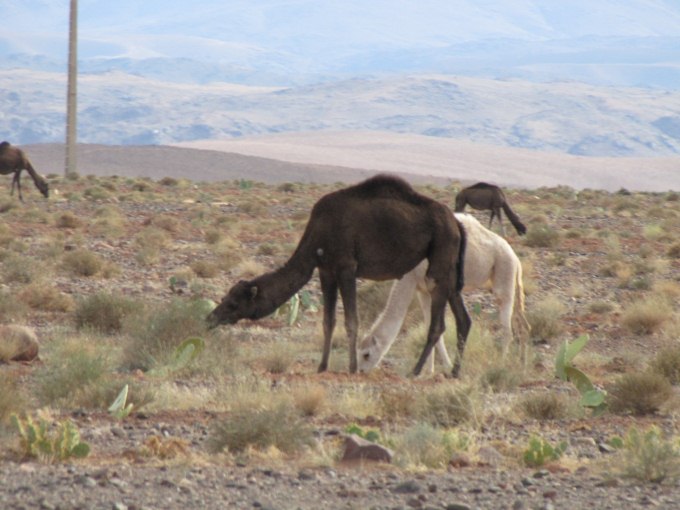
Camels feeding on the side of the road
As promised, one of the sacrificed sheep right outside our window
After the hustle and bustle of city life we slowed it down quite a few notches and went to check out some beaches along the western coast of Morocco. The landscape here is a dry rocky mountainscape dotted with many goats, sheep and donkeys and of course, cactuses.
Essaouira
Our first stop was Essaouira. This quiet fishing town, which resembles the Greek islands with its white buildings and blue accents, was very peaceful and hospitable. Essaouira was designed by the same Frenchman who designed Brittany’s most famous port town Saint Malot. However, it is nonetheless very Moroccan in the old town’s medina with the narrow alleyways full of colourful merchants. With its laid back atmosphere, this medina feels very different than those found in the big cities. The waterfront has the most seagulls we have ever seen likely due to the infinite amounts of fish in the port.
So, Essaouira’s most famous American son, Jimmi Hendrix, used to relax here in the 60’s and 70’s. Every guide book speaks of the fact that his song “Castles in the Sand” was likely based on an old castle in the sand found at the end of the beach. However, they then go on to say that the song was released two years before his first visit to Essouira. Not only was the man a legendary musician but he also seems to have be psychic J .
Kitesurfers, Essaouira
The beach at Essaouira is roughly 3 km’s long and is a famous windsurfing and kitesurfing spot due to its relentless wind. At the end of the beach one can find many camels and horses for beach rides and some small but nice sand dunes. Notwithstanding the wind and the ice cold Atlantic water, this is still a fantastic beach to relax on with its super fine golden sand. Strolling along the boardwalk that lines about half the beach you will be sure to encounter several children, as well as grown men, selling you quite delicious cookies (and “space cookies”) and will be sure to come across an evening game of beach football.
While in this quaint little beach town we had the pleasure of meeting Khalid, a leather salesman. This man is one of the most hospitable people we have ever met with a heart of gold. We met him by chance while browsing his store and after a few brief conversations he invited us over to his store for mint tea. After our tea he invited us over to his house for dinner where we had one of the best meals in Morocco by far (but more on this in our upcoming Morocco food post … ya, like we’d miss talking about food!!). After our amazing dinner, being a gentleman, he walked us home to ensure “we got home safely so that he could sleep ok”. This is where the story gets interesting and Khalid got more than he bargained for J . We got to our apartment only to find that the downstairs door was locked and the keyhole had fallen out, so of course, our key didn’t work. After much knocking and shouting with the assistance of a neighbourhood boy and downstairs neighbour, we realized we were definitely locked out for the night. Poor Khalid was stuck with us and not only did he offer us his home to crash in but he gave us his room and went to sleep with his roommates. We’re telling you, an amazing man!
Khalid and the gang
Our second stop was Agadir. Oh Agadir you tourist whore (pardon our language). This place is your typical Florida or European beach town with hundreds of hotels and restaurants lining the beach and surrounding streets (including a Club Med), a large boardwalk and a huge beach. Agadir itself is a huge city with it’s own medina but as we only spent a very short time here we cannot comment on much else but the touristy beachfront. Unlike any other place in all of Morocco, alcohol is available everywhere unless stated otherwise, hence the many British pubs.
Legzira Beach
Our last stop was Mirleft. This place was just amazing - so relaxing and the town is asleep by 10 pm. The main tourist drag resembles an old western movie with its dusty dirt road and two story saloon like buildings lining the street. While in Mirleft we had the pleasure of staying at Hotel Atlas (http://www.atlas-mirleft.com/), which was a great value with friendly staff, a fantastic cook and a massive rooftop patio. The perfect place to make your home base. We sat every morning in front of our hotel eating and watching the slow paced town folk go through their daily routines including the old man trotting by on his donkey. The beaches at and around Mirleft are quite spectacular, all surrounded by steep cliffs. We only made it to three of the five closest beaches, two within walking distance and the last one was a 30 km moped adventure. Picture the two of us on a small moped designed for a short 12 year old. M drove while S sat on the back bike rack on a very comfortable ¼ inch foam pad (do you sense the sarcasm here … S still can’t feel part of her derriere). The ride was well worth it as the beach we got to was simply amazing. Legzira Beach, with its dramatic natural stone archways reaching over the ocean and five kilometers of secluded beautiful sandy beach. We’ll let all the pictures do the talking but needless to say that Morocco’s beaches are well worth a visit.
After a very quiet first night in Casablanca where we finally got to watch movies in English while waiting for the other S&M to arrive from their long-ass flight from Vancouver, we arrived in Fez excited and ready.Our first real introduction to Morocco was our drive to the medina of Fes el-Bali (Old Fez) from the train station.Imagine playing your favourite car racing game without the speed but just as much heart pounding excitement and no road rules.This is what the drive to the entrance of the Fez medina felt like to us.For some reason our driver liked to drive in the middle of the road and sit on the horn.Parking, if you can call it that, was yet another adventure.He seemed to park in the middle of the road with cars and bikes honking and trying to manoeuvre around him while he just grabbed his keys locked the door led us to our new home.
Our crazy stairs (thanks Sara for the pic!)
Getting from the entrance of the medina to our place was crazy, it was a labyrinth of narrow streets leading in all directions from the main medina artery we entered on.A labyrinth in which we got lost several times over the course of the days that followed.We’ll get back to the beautiful Fez medina in a second, but let’s first tell you about the place we called home.We stayed in the heart of the medina in a three story traditional home with a rooftop patio and CRAZY small steep stairs. The stairs and the entrance to the bathroom have left lasting impressions (physical and metaphorical) on each of our heads. The owner of our ‘home’ is a British man who renovated this home and a dar (a traditional home with an internal courtyard) down the street to look as it would have originally.Both places were gorgeous and covered with customary Moroccan tiles (all made by hand) and each took two years to renovate.It was such a treat to stay here and a perfect home base from which to explore the marvellous medina.
Medina of Fes el-Bali (Old Fez)
The Fez Medina a.k.a medina of Fes el-Bali (Old Fez) is Morocco’s first World Heritage Site and both the world’s largest living Islamic medieval city and car free urban area. The medina can be quite overwhelming and intimidating at first with its narrow winding streets (lane ways is probably a better term) with shops, souqs (markets) and kissariat (covered markets) all along selling everything you can imagine, from spices, to shoes, to goat heads and hoofs.Also hidden throughout the medina were food stands, workshops, hammans (Turkish style bathhouses), fountains, medersas (theological colleges) and mosques (350 of them).The medina is alive and full of people.As no cars can get in goods are transported either by cart or by donkey.Tourists were far and few between off the main drag and getting lost is a certainty and TONS OF FUN!!You never know where the next turn will take you.To a newcomer, the medina might look like a maze of chaos but it is actually quite well organized.All the souqs (markets) and stores were organized by type in various locations throughout the medina.The produce and meats were always by the entry gates and the metal workers or tanneries or other markets were grouped together somewhere inside the medina.While in this medina, we really felt like we stepped back 100 years … minus all the cell phones and satellite dishes.
A view of the tannery from up top
During our stay we had the opportunity to visit the oldest tannery in the Fez medina.For those that don’t know, a tannery is where the tanning process is applied to hide to produce leather.The first thing you notice when nearing a tannery is the smell.And does it ever smell.Thankfully we were there on an off day so the smell was much milder than normal.Tourists are often offered a sprig of mint to hold up to their nose to take the edge of the smell (as we were).The smell is due to the major components used in processing the skins, which are pigeon poo and cow urine (for potassium) with ash.They also use less intrusive ingredients later for colour, such as indigo, saffron and poppy.The leather products we saw in Fez are out of this world – if you are going to Morocco and are looking for leather goods, make sure you buy them in Fez as the quality, prices and variety are unbeatable!!Fez was definitely one of the highlights of our Morocco trip.If you ever visiting Morocco, do not miss Fez.
Now on to Fez’s bigger and way more modern sibling, the city of Marrakech.From the moment we got off the train it was obvious that this city was nothing like Fez.From the McDonalds and KFC greeting us at the train station to the millions of cars and motorbikes in the medina, we realized that we had stepped into a new ball game.
Our apartment in Marrakech was nothing short of extraordinary... yet again.It was located steps from the train station and it housed two bedrooms, a large kitchen, a massive living room area and two balconies that were to die for.We had a housekeeper/breakfast cook that came by every day to make us food and clean up the apartment.The only down side to this whole place was the water pressure in the shower which can be compared to a dripping faucet.AND this was when it was on full blast.If you have ever seen the Seinfeld shower head episode you should know what we are talking about.
The food stalls at Djemaa al-Fna
The new Marrakech resembles any French designed city with big buildings and large boulevards with the exception that the streets are lined with orange trees and are much grittier, dirtier and dustier.The old Marrakech (the medina) is nothing like the Fez medina.It is large andvery very loud with lots of cars and motorbikes zipping all over the place.There are tons of shops lining the streets, however, unlike their Fez counterparts, these shops all sell the same merchandize.The attraction of the medina is the mayhem and bustle of the Djemaa al-Fna: the main square and open-air theatre.The Djemaa al-Fna square used to be the site for public executionsabout a thousand years ago hence its name which means “assembly of the dead”.This square comes alive at night with performers of all sorts.From snake charmers to an old man humming through a microphone with an eagle tied up next to him to the Gnaoua musicians.This makes for an unforgettable experience.There are orange stands selling freshly squeezed orange juice along the centre and outside of the square which S made sure to visit every chance she got.Around sunset there are hundreds of food stalls that set up shop in the square all under white sheets with their smells and sounds luring you in for some good Moroccan treats.
Before we sign off we wanted to mention that we both had different expectations in relation to the architecture and style of Morocco.We were expecting beautiful ornate carvings everywhere but discovered upon arrival that this detail can only be found at Mosques, theological colleges and palaces.As well, we can’t forget to mention that from now on Morocco will be known to us as the cat capital of the world.There were cats everywhere, just everywhere.Including inside the Casablanca airport at the check-in counter.
There are a number of ways to get around this country.Some very fun and others not so much.We luckily experienced them all and then some.
Morocco’s four major cities are all connected by train.The other 99% are reachable by one of many bus companies that operate in Morocco and the last 1% is possible to cover by a grand taxi.Since all of you are familiar with buses and trains we will take a moment here to disrobe a grand taxi and how it operates.
Grand Taxi Stand
Ok, so a “grand taxi” is almost always a Mercedes Benz that was manufactured anywhere between 1970 and 1985. It fits six people plus the driver (three in the front and four in the back) and it is used to travel between cities.Each passenger pays a set fee (which based on distance traveled) and each passenger can be dropped off and picked up along any given route as long as there is space available in the car.Here is an example of how this system operates.Each taxi leaves a taxi stand when there are six paying customers and travels from taxi stand A to taxi stand B.As you are driving along one of the original six passengers might get dropped off before taxi stand B at which time he is replaced by another passenger down the road that needs the services of the taxi.So, if you are traveling a distance of lets say 40km you might have 15 different people come and go before you reach your final destination.Once the final destination is reached the driver waits for another 6 paying customers and the fun starts all over again. J
Petit Taxi
Grand taxies are always used to travel from city to city.If you need to travel within a particular city then you would need the services of a “petit taxi”.This is always a hatchback made by Peugeot or Fiat.All of the petit taxies are painted the same colour and the colour varies from city to city.Petit taxies can take a maximum of three passengers (by law) and cannot under any circumstances drive outside the city limits.
We have to take a moment to tell you about our attempt to catch a taxi, any taxi, outside the Fez medina at the time of closing.We had been in Fez for about two days at this point and the four of us (S&M and S&M – M’s best friend and our kum joined us with his girlfriend for the first week of the trip… they happen to have the same initials… lots of S&M going on here J...pure cheese we know… but it amuses us) felt brave enough to attempt to get home via cab.Being from Canada the four of us did what any one of our country men would do and orderly lined up in what we thought was the lineup for the cabs that were constantly arriving.After about ten minutes of standing there and watching countless people go around us and take taxies we decided to abort the lineup idea and venture into no mans land.So, the first problem was getting a taxi to even stop for us. After a dozen failed attempts one finally did.We all piled into the car only to leave in frustration as the driver kept yelling “three” in French.Thinking that this was a tourist thing we repeated this process another three times.On our fourth attempt we were finally told that the petit taxies that we were getting into can only take three people by law.Our next plan of action was to grab one of these big old white Mercedes Benz cars that everyone kept piling into.This was much harder than it sounds.There were about two of these cars around at any given time.The thing we found the oddest was the fact that there were always seven people in this car.Not wanting to look like amateurs… again… we decided that the best thing to do was stand aside for a few minutes and see how the locals get these cars to stop for them.What we witnessed was that every time one of these white Benzes would arrive a swarm of people would literally fight for an available seat.Imagine playing musical chairs with about a hundred people and when the music stops the first six to pile into the car get a ride.This is exactly what this was like.Needless to say we didn’t even try to get into any of these cars.So we ended up taking two different petit taxies and we got dropped off in two different locations.Our friends got dropped off at the right location and the two of us about two entrances to the medina short.After wandering and trying to find our way home for about 45 minutes we ended up paying an eight year old kid to get us home and finally met with up with our friends.One for the books folks that’s for sure!
Moving onto the interesting Moroccan bus industry.There are two main bus companies that operate in the country.One is CTM and the other Supr@tours which is associated with ONCF (Morocco’s railways company).In addition to these two operators there are about a dozen or so privately owned companies that operate throughout Morocco.Some are great and some are as shady as can be.We got to experience both sides of the coin.Buses overall are very modern and comfortable.They leave and arrive on time but this can be said only for the two main operators.While we had excellent service from CTM and Supr@tours we were left a bit frustrated with some of the other operators.The frustration lies in the pricing structure (different price for tourists and locals), the fact that the bus leaves the station only when it fills up (this can add hours to your departure time), the quality and smell of the bus and the fact that the other bus companies will take anything from sheep to luggage in the luggage compartment of the bus.I kid you not, you have not lived until you see a luggage compartment open with a sheep and a goat tied to the inside both looking as confused as can be.Overall we both agree that the bus industry of Morocco is well organized and mostly reliable. We rate it 7/10.
A sheep in the cargo space of a bus
Remnants of the accident :( *photo courtesy of Sara
The railway system is pretty impressive we have to say.The trains are clean (with the exception of bathrooms which we would not wish upon our worst enemy) and very reliable.We experienced the train on five different occasions and three out of these five times they arrived and departed on time.The last time was right after a big holiday in Morocco and the train schedule was all over the place.Our first impression of the trains was arriving into Casablanca from the airport.We will be honest and say that we were pretty skeptic but the train that greeted us was clean and much better than a lot of the trains we had throughout Europe.It left and arrived on time.On our way from Fez to Marrakech we had a bit of an unfortunate accident where our train hit a crossing car and we were delayed for about 3 hours.After the operator noticed that our train was not operational we had another train pick us up and take us the rest of the way.On our way from Marrakech back to Casablanca we were traveling during the above mentioned holiday and the rail company added trains to the schedule to meet the demand.Very cool indeed!We rate the train service 7/10.All points were lost because of those horrid bathrooms.They still keep us up at nights!!!! J
We won’t comment on the plane portion of the trip as we took the planes to only get into and out of the country.But we will say that the Mohammed V airport in Casablanca is very modern looking but also very backwards.They have flights leaving past yet the entire food court closes after 9.So if you have a flight leaving late pack yourself a sandwich or buy food before you arrive at the airport.The phones in the terminal all have a calling card slot but only take coins (but none of them were operational).The security check was a joke and we’re not the ones to harp on security but if the metal detector goes off as someone is walking through it, please check that person and don’t just wave them through because they are a tourist and a female.It was very bizarre and a bit alarming to say the least.We rate the airport experience a 6/10.
Settat Train Station (waiting for our replacement train)