Showing posts with label Nepal. Show all posts

January 9, 2011

Food in our 4th Moon

Of course we must finish off our Nepal posts with a little on the eating we did (here it finally is Stro!). There are four types of foods to be found in Nepal: Nepali, Tibetan, Indian and Chinese. There are restaurants that are strictly Nepali or Tibetan while others offer all four cuisines as well as continental which consists of pizza and spaghetti Bolognese. Most Hindi Nepalese are vegetarians, some by choice and others out of necessity. In the Kathmandu Valley, however, the Newars are big meat eaters with buff (water buffalo) the meat of choice as cows are sacred and never eaten.


daal bhaat tarkari with a carrot and daichon salad and a papad
The STAPLE in Nepal, and we mean eaten three times a day staple, is daal bhaat or daal bhaat tarkari (daal bhaat is lentil soup and rice and tarkari is curried vegetables). The daal bhaat (tarkari) is served on a large metal plate with raised edges. There is a large pile of rice on the bottom half of the plate and there are one or more bowls along the top to house the daal, tarkari or anything else that may be served such as hot sauce or achar (pickled vegetables, we think). To eat daal bhaat the local way you pour the soupy daal onto the rice and mix it into balls with your fingers. If you have tarkari add a pinch of the curried vegetables and shovel it into your mouth with your right hand. We were always offered a fork and gladly used it. As they eat with their hand, there is a sink by the dining tables for everyone to wash up before and after their meals (and they need it after, as their hand is covered in sauce and food … no no no, wait, not food, as they lick that all up). Sometimes you get offered a salad, which means carrots and daichon (a white root). A cool thing at local restaurants is that while you’re eating someone goes around offering you second helpings of all the ingredients at no extra cost. A very cheap and tasty way to dine.

You can wash down your daal bhaat with a beer - either local home brew or your store bought beer. The Nepali beers are Everest and Nepali Ice and most popular foreign beers available are Tuborg and San Miguel (both brewed under licence in Nepal). All the beers are only available in a 655 ml bottles J rather than the smaller bottles we‘re used to at home. Here’s a useless piece of information: Everest beer had a special addition bottle out while we were there dedicated to the Sherpa who climbed Everest nine times. He had seven brothers and they have each climbed Everest at least once, or so the label says. Fascinating, we know. 

The local home brew is called tongba which is made by pouring boiling water into a metal (or wooden) pot full of fermented millet and is sipped through straw made of same material. This brew tastes like warm watered down saki and it is kind of sour but surprisingly drinkable the more you sip on it J . Speaking of watered down saki, we also sampled the local wine (moonshine) which is made from rice and the locals call it raksi. Raksi is a cloudy drink almost passable for water and tastes between a watered down rakija and saki. Not the greatest but drinkable and does the job J J … our guide got pretty tipsy after a few of them. The raksi is stored in various containers; we had the pleasure of getting served out of a spare gas container as well as a small plastic bucket commonly found in bathrooms around Nepal. *disclaimer, no we do not have a drinking problem*


sukuti on the bottom, wet buff on top and a side of hot chilly sauce
So we spent an evening at a local ‘bar’ J with a local store owner (possibly wino). The bar looked like any other local hole in the wall except that there were lots of people from what we could tell getting shit faced in the back. At one point a man walked in through the front entrance with a tree on his shoulder, we kid you not, and walked to the back with it. When he walked out, he was treeless and much more wasted, yelled something and gave us high fives.  At the local ‘bars’ there are no menus and your choices are few but delicious. Alcohol wise you can have beer, local beer or wine or Captain’s Choice Whiskey (the label has an airplane captain on it smiling while holding up a bottle of whiskey). With respect to food there is always vegetable chow mein, wet buff or sukuti. Sukuti is dried meat which can be served on its own or with soya beans, onion, garlic and green chilli. Buff meat is pretty tough to chew, especially when dried (sukuti), so the wet buff dish is pleasant change with its juicy buff meat cooked in a chilli sauce along with tomatoes, onions, chillies and ketchup. Both are delicious but as mentioned the wet buff is a nice break for your teeth.


steaming our momo's
 Our guide also took us to a few good places to sample local fare. On our first hike he took us to a place on the mountain side with probably some of the best momo’s we had in Nepal and the best bean salad ever!! Momo’s, which are Tibetan, are dumplings that can be steamed or fried (steamed are way better, hands down) and are usually filled with buff. They seem to have become a favourite snack with traveller‘s - so popular that Coke has ads with momo’s.

One of our staples while in Nepal when we could get our hands on it was Tibetan soup. This simply delicious soup is called thenthuk or thukpa, depending on the type of noodle used (either thin and long or flat and rectangular). All the food is made from scratch when it is ordered, and we mean from scratch … they make the noodles and the momo dough and then prepare, (stuff) and cook. While frequenting the Tibetan restaurants, we also sampled Tibetan bread which, like momo’s, comes either steamed or fried. Again, we are in favour of the steamed variety. Our second staple in Nepal was tea with every meal, which came in pretty handy in the chilly evenings. They had such a large variety of teas including delicious fresh lemon and/or ginger and/or honey tea. We miss both the Tibetan soups and all those wonderful teas so much!!

Overall we would say that Nepali food was good but got boring fairly quickly. On the other hand, we really enjoyed Tibetan food and could eat it again and again.


a  nice Chinese and Nepali buffet we had after our first hike
  
making momo's (we hear ash is a healthy addition)

Thukpa - Tibetan soup
 
yummy bean salad


a delicious street snack of mixed nuts, chilli, oil, tomatoes and dried noodles
 
fried Tibetan bread

the local wine, raksi, being made
 
steamed Tibetan bread and veggies
 
M with his 'special edition' Everst beer

momo's in a chilly and tomato sauce

Oh Coke
 

January 8, 2011

Nepal: Buddha's Birth Place


Buddha inside Chinese Monastery
Our last stop on our Nepal tour was Lumbini, a very small town close to the Indian border. Lumbini’s only draw is the fact that in 563BC Siddhartha Gautama, a.k.a. Buddha, was born there. As such, it is a pilgrimage sight for Buddhist from all over the world.

The exact spot of Buddha’s birth was by a lake under a Bodhi tree which is now marked by the Maya Devi temple. This temple is set in the middle of a large 4km by 2.5km park known as Lumbini Development Zone, which was designed by Japanese architect Kenzo Tange in the late 1970’s. It is a work in progress as it is in need of funding. At the moment, there is a dry canal that separates the Development Zone into two Monastic zones: the West Monastic Zone, which houses Buddhist communities from the Mahayana Buddhist sect and the East Monastic Zone, which houses Buddhist communities from the Theravada sect. Each sect has its own interpretation of Buddhism and can be distinguished by the colour of the robes worn. The Mahayana school wears maroon robes and the Theravada school is recognizable by its saffron coloured robes and is common in South East Asia and Sri Lanka.


Royal Thai Buddhist Monastery
Within the Development Zone Buddhist communities from around the world have built or are building monasteries, with the German Monastery in the West Monastic Zone (called the Great Drigung Kagyud Lotus Stupa) being the most colourful and ornate one we saw and the Thai style monastery or wat, called the Royal Thai Buddhist Monastery, in the East Monastic Zone, being the most beautiful and impressive being built all in white marble. When finished, the Development Zone will be comprised of landscaped lakes and monasteries constructed by Buddhist communities from around the world with a vision for the sacred garden to be entirely surrounded by water and only navigable by boat.


M all sexy on his bike
Outside of walking or biking around the peaceful Development Zone, there is really nothing else to do in Lumbini. The Lumibini Bazaar, which sits outside the Development Zone and houses a restaurant and a few guesthouses is nothing but an intersection where the buses drop everyone off. We have to say that around Lumbini was the dustiest and smoggiest area we have been to in Nepal and the only place we chose to ride with our luggage on top of the bus. Go figure. Needless to say it was a very dusty, dirty and bumpy ride.  

For more pictures, as always, click HERE (password: buddha). 
 

ruins from 2 - 5 AD of stupas and monasteries with Maya Devi Temple in the background

prayer flags

Mahayana monks

German Monastery

riding the bus to the Indian border


December 31, 2010

Nepal: Hiking Closer to the Himalayas


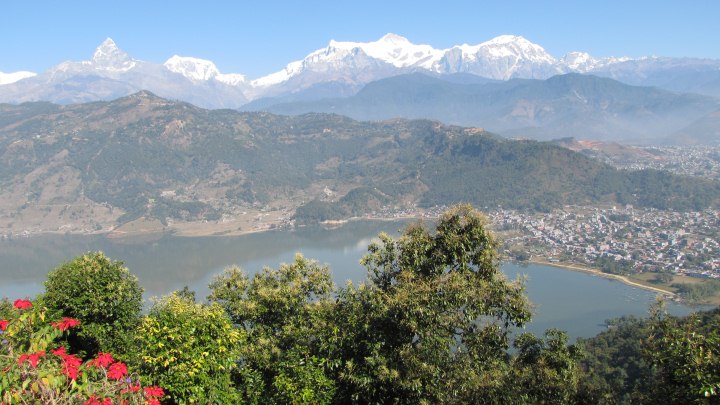
view of Pokhara and Phewa lake from World Peace Pagoda
Before arriving in Nepal we played with the possibility and our ability to do the 21 day trek to Everest base camp which sits at a measly 5360 m above sea level. We opted instead for the beginner version in the form of two separate two day hikes. We booked our treks or hikes through the hotel’s travel agency, Global Adventure Trekking (P.) Ltd., which is one of hundreds of travel agencies in Thamel as every, and we mean EVERY, hotel, guesthouse and B&B has their own agency.  Global Adventure Trekking did a wonderful job and lived up to all their promises!

Our first trek started from a small village outside of Kathmandu (1337m) and climbed to the village of Nagarkot sitting at 2175m and overlooking the western Himalayas. After our five hour hike (a cold beer and a two hour nap) we enjoyed a beautiful sunset from the hotel’s rooftop viewpoint at 2194m. What a view! Our second trek started from the other side of Nepal in the beautiful mountain town of Pokhara (1025m). Our destination this time was Nagarkot’s sister city, Sarangkot, sitting at 1600m. Although lower than Nagarkot, this little village was much closer to the Annapurna range (the eastern Himalays) and therefore afforded magnificent mountain views not to mention the most amazing sunset and sunrise! Although this was a shorter trek, it was much warmer and MUCH steeper. It was not so much a trek as doing a stairmaster for three straight hours after a two hour hike to the World Peace Pagoda. S was kind enough to stop every 15 steps to take pictures of the breathtaking surroundings. 


boy with a Doko
On both hikes the views were unbelievable. Not only did we enjoy clear mountain views but our walk was through beautiful tiered farmland and many villages. Every possible piece of land on the mountain side is used for farming. It’s not laid out like the farmland that we are used to seeing at home. It is all on layered land that follows the contours of the mountains and is divided by mounds of earth. It reminded us of rice fields without the water. Quite amazing. Another quite amazing thing is the way the Nepali carry loads - they carry them in a basket called a Doko that sits on their back and is strapped to their forehead. The mind blowing thing is that they carry bricks, wood, and litres of water all at the same time. They seem to carry easily hundreds of kilos at once. Simply unbelievable. We heard that the trek porters also strap backpacks to their forehead to help carry the weight.

If we had to pick a winner between the two destinations it would definitely have to be Sarangot for it’s proximity to the Himalayas and it’s view of Pokhara’s Phewa-Lake and the valley surrounding it.

 Click here for more pictures (password: viewpoint).


farmland on the way to Nagarkot

view on the way up to Sarangkot
 
view of World Peace Pagoda from Sarangkot

view from our balcony in Sarangkot

getting ready for the sunrise, Sarangkot

sunrise, Sarangkot

sunrise over the Annapurina range (view from Sarangkot)

Our hotel in Sarangkot


December 27, 2010

Nepal: Relaxing Pokhara


Annapurna range at sunset from Pokhara
 Our favourite city in Nepal during our 18 days there was definitely Pokhara.  This town is perfectly nestled between Phewa lake and the Annapurna range (the western portion of the Himalayas in Nepal). Although a popular tourist destination it is a very tranquil town and the surroundings are just beautiful.  In terms of tourist attractions, there is not much to see here, which leaves you with plenty of time to enjoy the surrounding natural beauty.  And enjoy it we did. 


washing laundry along the river
 The main "tourist strip", which consists of shops and restaurants, runs along Phewa lake.  Here you will find the same merchandise you could find anywhere else in Nepal but in a much less hectic atmosphere.  We enjoyed an afternoon of boating on Phewa lake and around a Hindu temple on an island in the middle of the lake.  Another day was spent walking along the river to the waterfalls and caves a few kilometers away.  The waterfall is named "David's falls" after a tourist who was taking a bath in the river above the waterfall and got washed down and unfortunately killed.  Crazy to believe but there is a plaque there in Nepali English explaining the whole thing.  As we were there during the dry season, there was not much water falling to see but the walk there was fantastic.   All along the river people were bathing and washing their clothes - a beautiful kaleidoscope of colours. 


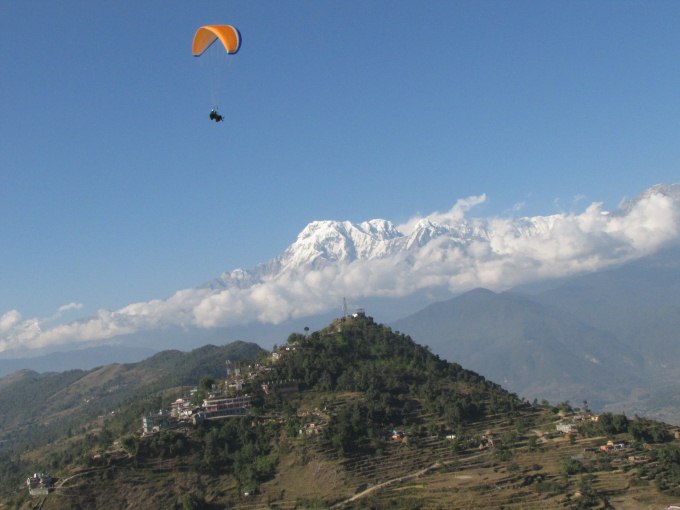
the view from M's paraglide

Another worthwhile walk for the breathtakking views is the three hour hike up to the World Peace Pagoda which sits on top of a hill on the other side of Phewa Lake.  But talking of breathtaking views, the best views we had of the Pokhara valley were from our paraglides.  Yes, you read that right, we went paragliding for the first time in our lives and can't wait to do it again.  Pokhara is one of the top spots in the world for paragliding as the weather is very consistent from September to about January.  We took off from Sarangkot and after an hour flight we landed by the lakeside.  We soared hight above Sarangkot mountain and the Pokhara valley with the vultures and eagles.  The experience was unforgettable!

For more pictures of Pokhara and our paragliding experience, click HERE (password: relax).

conquering Phewa lake

view from the World Peace Pagoda

the World Peace Pagoda

S flying over Sarangkot

traffic over Pokhara and Phewa lake

flying with the vultures

December 22, 2010

Nepal: Chitwan National Park

Our next stop on our tour of Nepal was Chitwan National Park, which is a World Heritage Listed Park reserve that protects over 932 sq km of sal forest, water marshes and grassland. The park boasts 50 different species of mammals including rhinos, royal Bengali tigers, deer, monkeys, wild elephants, leopards, sloth bears and wild boars, as well as 500 different species of birds and butterflies. The one-horned rhinoceros is the most famous animal in Chitwan and one that you are likely to see. The tiger, on the other hand, is a rare sight as there are only 100 or so in Chitwan and they are nocturnal animals.

Before we get into the details of our jungle adventure we must tell you a bit about our bus ride to the park and the bus system in Nepal in general.  The only way to get around the country economically is by bus. Buses reach as far up the mountains as conditions will allow and have a very interesting organization system. Though they aren’t the newest and at times not the most comfortable for tall people, they sure are efficient and an adventure! All the buses (and trucks) are made by Tata, an Indian conglomerate, and we’d say 98% of them are pimped out with designs and murals on the outside and sometimes inside by the cabin. Pretty funky to look at. The insides vary in states of disrepair, with the local buses having the most wear and tear, but they still get you to your destination. We can see why they would be in those conditions due to the state of Nepali roads: either lots of dust and dirt or lots and lots of rocks. Let us tell you a bit about how the buses works. There is always a young boy working the door of the bus. The boy has many jobs from taking all the payments to helping the driver navigate the roads and traffic to soliciting passengers. So what this young boy does is he hangs out the bus door as the bus drives along and yells to the people on the side of the road the buses destination. If someone indicates they want to get on, he bangs once on the side of the bus and the driver stops. Once that person is on (and the luggage has been thrown on the roof) the boys whistles or bangs twice on the side of the bus and the driver takes off and the boy collects the money. This continues throughout the journey. Likewise when someone wants to get off, the boy bangs once to stop the bus, grabs the luggage off the roof, hits the bus twice or whistles to start it up again and then runs to get back on the bus. The boy also removes obstacles from the road and is the driver’s left side mirror when navigating through heavy traffic or narrow streets - he bangs in successive double taps to let the driver know that he has space to pass. Note that all of running, climbing and jumping on and off the bus is performed in flip flops J .

Now a little about the ride itself. Besides being highly entertaining and at times scary (overtaking trucks on blind corners on the side of the mountains in single lane roads) the bus is made for much much shorter people and the windows and doors rarely stay shut. On our ride to Chitwan, every five minutes M would shut the window in front of us leading to the cabin and the window next to us as it was quite cold and we wanted to keep the dust out. It was so dusty that the trees and bushes lining the road were grey rather than green (see picture here: sad grey trees ) and shockingly, villages were drying their laundry along the side of the road. The windows weren’t the only thing sliding open throughout the ride. As we bumped along, the door latch would slowly start to turn and eventually the door would swing completely open. We would ride with the door open (and S&M giggling) until the boy would notice and latch it again. Simply priceless.

water buffalo in the fields of Sauraha
So we finally arrived to Sauraha which is a small village in the parks buffer zone. The first thing that is noticeable as you step off the bus is the clean fresh air and peacefulness of the place. Coming from Kathmandu which was very noisy and polluted this was a welcome change. The area of the village is surrounded by yellow flower fields and native mud huts (houses of the Tharo people). There are elephants and water buffalos everywhere. The first thing we did upon arriving at our hotel was take a long overdue shower. Due to the water shortages and consistent power outages that are more than common in Nepal’s winter months we were unable to shower for the last four days we were in the Kathmandu Valley (note: two of the four days were spent hiking the Himalayas). Yup we are your typical North American prima donnas J .

We spent a total of 3 days and 2 nights at hotel Parkland in Sauraha. They had our whole itinerary planned out for us from the time we woke up to the time we went to bed. This was probably our least favorite part as we both like to explore and do things on our own time … but when in Rome (or in this case Chitwan) do as they do (or say!). Our action packed days included a few nature hikes through the jungle, a beautiful sunset buy the river, a canoe ride down the river (this is where we got our first look at the crocodiles that are quite common along the river side), a visit to the elephant breeding centre and an elephant back safari. All in all we saw and experienced a whole lot. The highlight of the visit was definitely the elephant back safari into and through thick jungle. What magnificent animals. For such a large and powerful mammals it’s amazing how gentle they can be. We both fell in love. While we are on the topic of elephants we also got to visit with a local elephant on our first night in Chitwan. We sat next to him while he was being fed “Kuchi” which are bundles of grasses filled with rice, molasses and salt, while our guide Hari told us all about the captive elephants as well as the difference between Asian and African elephants. We can’t remember them all but one of the differences is the ears with the African elephant having the big ears shaped like Africa (i.e. Dumbo) where as the Asian elephant has small ears shaped like India.

We saw so many animals that one can only see when visiting a zoo in most parts of the world. On our first day we saw two one horned rhinos grazing by the side of the river. During our forays into the jungle we saw many crocodiles, spotted deer, brown deer, monkeys, water buffalos, peacocks, many different birds including storks, wild boars and the ever dangerous wild chicken! What a great experience!!!


As always, here are a few pictures with many more HERE (password: elephant).

cute young female elephant


school children on a sunset canoe trip
  
one horned rhinocerous
 
inside Chitwan National Park
 
ending our elephant safari
 
scenery on our canoe cruise