March 23, 2011

Five Centuries in the Making - The Ellora Caves

M suffering on our bus ride
After Udaipur we made our way to Aurangabad, the launching point to see India’s famous Ellora and Ajanta caves.  Before we tell you about these masterpieces we have to tell you about our terrible bout of traveler diarrhea (also known as Udaipur Belly taking its name from the famous Delhi Belly or Calcutta kaki’s - Thanks Miki for this gem).   For the faint of heart, please skip to the next paragraph.  The story starts in Udaipur where S’s sickness began. We think the source was cappuccino’s we had (while they used fresh milk to make our coffee, our guess is that there was old milk in the machine) as right after the little cup, S spent the rest of night in the bathroom purging the nastiness from all holes.  Gross we know.  The next day we traveled 24 hours by bus to get to the shit hole of Aurangabad (our view may be tainted by the illness) and during our second bus trip the milk caught up with M -- so he let it all out the bus window and both of us came down with a fever.  To add to our misery the bus broke down for an hour and a half.  Good times.  By the time we reached Aurangabad in the morning, we had eaten a few crackers and bananas and were weak and delirious.  We had not booked a place in advance as we were arriving in the morning and wanted to see a few places before committing.  Normally a good idea but not in our state.  We had the rickshaw driver take us from one shit hole to the next (without the aid of a guidebook - bad idea) before we gave up and just settled down.  While the place may have been nice centuries ago it was a true shit hole - dirty, falling apart and infested with cockroaches.   We pulled out our sleep sheets, ordered water and plain rice and spent the next two days sleeping and sh**ing some nasty stuff.  By day 5 (or 4 for M) we were almost back to 50% of our strength and decided to get out of our hell hole and see the Ellora caves armed with water and plain crackers.
 
Magnificant Hindu Kailasa Temple
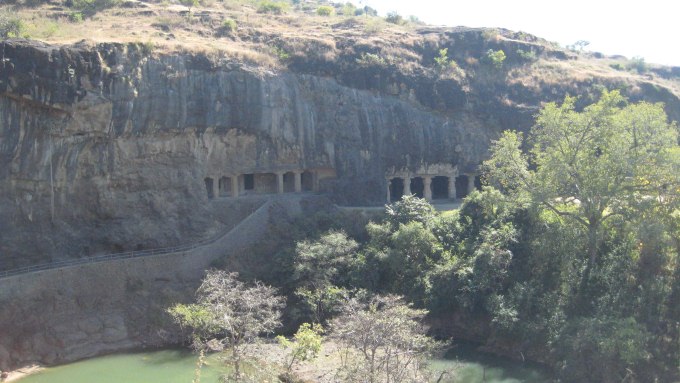
Aurangabad is a launching point for visiting the nearby Ellora and Ajanta caves, though the city has its own often overlooked group of Buddhist caves 2km north which were carved out of the hillside around the 6th or 7th century.  The World Heritage listed cave temples, monasteries and chapels of Ellora are about 30km from Aurangabad and were cut out from a 2km long escarpment over 5 centuries by generations of Buddhist, Hindu and Jain monks.  Once you get up close and see the intricate carvings everywhere which were all done by hand, of course, it is easy to see why a majority of the caves took so long to complete! There are a total of 34 caves: 12 Buddhist (600-800AD), 17 Hindu (600-900AD) and 5 Jain (800-1000AD) and their co-existence at one site evidences a prolonged period of religious tolerance which mostly continues to exist throughout most of India (sadly, aside from Kashmir).   The Hindu caves were very ornate and dramatic compared to the simpler and calmer Buddhist caves, with the masterpiece at Ellora being the astonishing massive Kailasa Temple. This temple is in the middle of the 2km stretch and is dedicated to Shiva and is the world’s largest monolithic sculpture cut from rock by 7000 labourers over a 150 year period.   The 30 Buddhist caves of Ajanta, 166km north-east of Aurangabad (better reached from Jalgaon which is only 60km away) date back from around 200 BC to 650 AD, therefore predating those at Ellora.  As Ellora developed and Buddhism gradually declined the Ajanta caves were abandoned.   These caves are also listed as a World Heritage Site by UNESCO (the United Nations Educational, Scientific and Cultural Organization). 

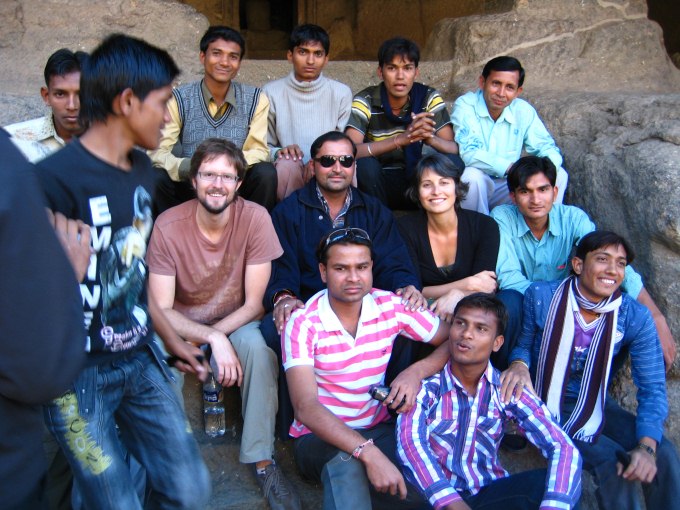
rock stars in the making :)
While we had the intention of visiting all three sets of caves, because of our illness and resulting irritation with the city and nasty hotel, we wanted to get the hell out of there and only ended up visiting only the Ellora caves. We have heard that the Ajanta caves are extraordinary to see and we look forward to visiting them on our next trip to India!   The trip to Ellora will take you the greater part of a day and make sure to bring with you lots of water and your picture perfect smiles because if your experience is like ours you’ll be getting your picture taken with school kids all day long.  We felt like movie stars!  We spent the greater part of an hour at the Kailasa Temple posing with various groups of kids or families (most wanted individual pictures and then group shots).  LOL.  Pretty funny but tiring as you finish one set of photos, are ready to walk away when the next group or family gets their courage up to ask you if you can pose with them. 

We have to give a special thank you for the creators of a wonderful website we found that allowed us to book our bus out of Aurangabad: www.redbus.in.  This website not only allows you to book your own bus rather than going through a travel agent but it also provides you with pictures of the buses and user reviews.  A fantastic tool for those traveling in India!

For more pictures of this amazing place please click HERE (password: caves1).

view of some of the smaller Hindu caves

incredible detail inside one of the Hindu caves

not a stone left un-chiseled - check out the lotus flower on the ceiling!

walking towards the Buddhist caves

from the inside looking out at the serene surroundings

tuk tuk's waiting patiently at some of the farther away caves

one of the more unique carvings

chilling at a temple entrance in one of the caves

another beautiful mural on a cave wall

one of the more ornate Buddhist caves - the ceiling is mind blowing in person

a little burnt out and low energy half-way through the day

March 14, 2011

Udaipur

Before we begin this LONG OVERDUE post, we would like to apologize for being so many months behind but we have to say, it really isn’t our fault. We don’t want to make any excuses, but … our excuse is that ever since we finally got to hot weather in mid-January, the sun fried our brain and slowed us down! So you see, we couldn’t help it!! That being said, we have taken lots of vitamins and built our strength back and hopefully we are in good enough form to get back on track. J


Lake Pichola and Water Palace in the distance
 As you know from our post on January 1st, we spent new years in romantic Udaipur sitting on Lake Pichola (a wonderful couple we know got engaged here and the romance is still flowing between them as they now have a beautiful daughter!). We have to admit that we didn’t love the city at first and didn’t feel the romance. While we saw the beauty in the design of the city with its intricately designed Lake Palace on an island in the middle of the lake and the ornate havelis and hotels lining the lake shore, we found the city to be overcrowded with tourists and the streets around the hotels lined with too many stores selling the usual: jewellery, clothes and all the other stuff found all over Rajasthan. However, we decided to give the city a chance and stayed a few extra days and finally understood its allure. We had to remind ourselves that it is only natural for a place always swarmed by tourists to become touristy and that you have to take it for what it is to really appreciate it.


bathers with one of the many boat rides going by
 Udaipur was founded by Maharaja Udai Singh II in 1568 and has the famous Lake Palace that covers the whole of Jagniwas Island (approximately 1.5 hecters*). Built 1754 it was originally the royal summer palace but is now a luxury hotel (visitors are not allowed unless you have lunch or dinner reservations). The royal families divided the rest of their time in Udaipur between the enormous City Palace complex which takes up a large part of the east bank of the river and during the monsoon season at the Monsoon Palace sitting on a distant mountain range overlooking the city. There is another island palace on Jagmandir Island which is flanked by a row of enormous stone elephants. A popular tourist excursion is a boat ride out in lake Pichola around the two islands. We have to say, this is really a worthwhile trip!

Besides the boat trip and just strolling through the many areas of the city, you can also walk along the shore and check out the bathing and dhobi (laundry) ghats. We also stumbled upon the old Muslim quarter and found that all the Muslim women here did not wear the usual hijab or burqa but had a very beautifully embroidered skirt and top with a hood - it reminded us of what little red riding hood wore. We ended up seeing this again in another city in India later on in our travels. Another cool thing about the city is that most of the hotels in the old town on or near the lake are tall with rooftop restaurants or sitting areas with beautiful vistas of the city, lake and surrounding mountains.

Note: For you movie buffs Udaipur was the backdrop for the James Bond flick “Octopussy”. It’s hard to visit this city and not be reminded of this fact as most of the restaurants play this movie nightly.

To see more pictures of our time in Udaipur click HERE (password: palaces).

one of the dhobi (laundry) ghats

another laundry ghat with the Lake Palace in the background

our room at the Lal Ghat Guesthouse

ain't we cute?!? :)

people hanging out and swimming at one of the ghats

women doing the laundry

hardest workers in India: women and donkeys.  Imprssive, carrying a baby and loading bricks!

another woman hard at work ... seeing a trend yet??

a merchant carrying his goods through the streets of Udaipur

donkeys hard at work

ladies and their babies


February 25, 2011

Transportation in India

We have a lot to say about travel in India as we spent a large number of the 58 days there making our way around the vast country. We travelled our way from India’s northern border with Nepal all the way down the west coast to Gokarna (almost made it to its most southern tip but unfortunately our expiring visa told us it was time to leave) and there was a minimum 11 hours of travel time between most of our destinations. Overall our traveling experience in India was great. The country is very well connected and easily and affordably accessible through an excellent mixture of air, rail and road transportation. We can only comment on India’s rail and road transportation as we only took one flight and that was out of the country.


a double bunk on one side of the aisle in A2 class
 Let’s begin with train travel in India. India has an amazing railway network that connects all corners of the country and efficiently moves its 1 billion inhabitants… and not surprisingly you have to book way in advance! Sometimes this is weeks or months in advance depending on your destination, class and date of travel - especially if you are looking at a direct train for long distances with only once a week service. Buying your first railway ticket on your own in India can be a confusing experience as there are eight classes of travel available and you can purchase your ticket under three different quotas. These are the general quota, the tatkal quota and the foreign tourist quota. The first two you can purchase in person or on-line where as a tourist quota ticket must be purchased at the station. The tourist and tatkal quota (tatkal seats become available 48 hours before travel time at a price increased by 5-25% of the original ticket price) are there to ensure that last minute travellers and tourists can get seats. 


the four person sleeping area in the A2 class
 There are up to eight different class options when selecting your seat on Indian trains though not all trains offer every class. At the top of the list is the A1 (air conditioned first class) for longer or overnight trips. This is a sleeper car which sleeps two people and has a locking door. You get two sheets (one for the bedding and one to put your blanket on), one thicker blanklet (comes in very handy when travelling through the northern provinces in the winter months) and a pillow. This is by far the most luxurious way to travel in India and has a price tag to go along with it. We never chose this option as the two lower A classes offer similar luxury with only a few differences at a discount. The A2 (air conditioned second class) is divided into a four person section on one side with a curtain closing it off for privacy with a double bunk on the opposite side of the aisle which lies along the length of the car and is also closed off by a curtain. If you’re lucky you get the double bunk. The A3 (air conditioned third class) fits in more people with six to one side and a double bunk on the other side of the aisle and has lower quality sheets, blanket and pillow compared to A2 (which in turn has lower quality than A1). Then you move down to the sleeper class which is the same in size and layout as the A3 except that you do not get any bedding, there are no curtains dividing the areas and no air conditioning. The cars themselves are built differently without the glass sealed windows of the A class (these are slats and in the lowest classes, just bars) and the frames and seating are of a lower quality. Needless to say if you are travelling in the winter and get a sleeper car, bring a blanket as it gets cold in there. Sometimes a non AC first class sleeper offered, with double or quadruple lockable berths, then you have your two AC seater classes and finally the unreserved second class. This last class is what you see in movies with open doors and wooden or padded plastic seats and yes, it does get rammed with people and people do hang out of the door. 

With our way of last minute traveling we only had the chance to use the train on a handful of occasions and all but one of the times we were waitlisted to get on. How the waitlist works is when all the seats are sold out you get put on the list and hope that people cancel their trip so you can get their seat. You are notified by email and/or text telling you that you are off the waitlist and will be issued a seat. So how do you find out what seats you were given? There are rows of boards in every train station with lists of all the passengers leaving on the trains in the following two hours. The lists are organized by train number, class and finally cabin number. The lists are then organized by seat number and provide the full name, age and gender of each passenger assigned to each seat. The lists are also posted on the door of the two entrances of each car but only the lists with the passenger info for that particular car are posted.

chicken lollipops
One of the best parts of traveling on the train, especially when you are going on long hauls, is the variety of food that is available for sale at any given time. The chai merchant passes by every 15 minutes followed by men selling chicken and veg biryani, omelettes, samosas, chicken lollipops (chicken drumsticks which are breaded and fried and smothered in hot sauce), tomato soup (very random we know :), and a variety of chip like snacks and pop. Although the food might not be the best, considering its train food, it’s not bad at all.


chhatrapati shivaji terminus (Victoria terminus), Mumbai
 Before we leave off to talk about the bus system, we have to tell you a little bit about the train stations themselves. On our first visit we arrived in the late afternoon and the station was as full of people as you'd expect any station in India would be. We came back a few hours later to find out that the population at the train station had tripled with people not only buying tickets and standing around but making themselves comfortable all over the floors with blankets and dinners.


in our first double sleeper bunk
 Since we could almost never find an available seat on a train we ended up travelling a lot by bus. We were pleasantly surprised to find out that for long distance buses there is a sleeper option. A sleeper bus is a regular sized travel bus that has been converted into horizontal cubes that sleep either one or two people. A bus can be either a complete sleeper bus with only single and double bunks lining the bus or it can be a bus with seats on the bottom and single and double bunks on top on either side of the aisle where the luggage racks normally are. We have to say that we really enjoyed travelling in a sleeper bunk although on one occasion the bus was really disgustingly dirty. We eventually found a fantastic website (www.redbus.in) where you can easily find route information and book and print your own ticket but the best part is that the bus companies are rated and pictured so you know what you are getting into before hand. 


inside a Mumbai taxi
 Once we made it to the many cities we encountered more options of transportation. Every city that we visited had some form of a bike or auto rick-shaws (tuk-tuk) that would line the corners of busy streets and thruways. There would be hundreds of them at any bus or train station and riding in one was an adventure to say the least. Then there were your standard cabs which really stand out in Mumbai with their yellow and black paint job in addition to their funky interiors. We highly recommend taking one if you are ever in this city as the feel of being in one is an experience on its own. In addition to being driven you can rent yourself a moped, bike or car and join the madness on the streets. While on the Goan coast we used a moped quite a bit and found it to be a great way of exploring the local beaches and towns. 

Overall we have to say that traveling throughout India was a comfortable, safe and enjoyable experience. The country is really well connected with affordable options of which we found the train to be the most comfortable if you can get a seat on one. Buses were a great second option with some variation in their appearance, smell and capacity. Both buses and trains are almost always late but jus as often happen to leave on time.
 
taxi's outside of Victoria Terminus, Mumbai

front of a cargo truck in India - they are all pimped out in their own way
 
back of  a Cargo truck in India with the stanard "Horn Please" as you are to honk so it'll get out of your way for you to pass
 
getting around on a moped or bike (note that almost all women sit sideways so they have special footrests for that)
  
a mixed sleeper/seating bus

a full sleeper bus ... with a man caught in action :)

the dirtiest sleeper bus we ever took - yes we tried to touch as little as possible ... wished we could float!
  
an auto rick-shaw or tuk-tuk in Varanasi
 

February 18, 2011

Jaisalmer: India’s Golden City

We left the chaos of the ‘pink city’ behind and took our first overnight sleeper bus (more on this form of travel in our up coming travel post) to Jaisalmer, also known as the Golden City. Before we fill you in on this sandy outpost, let us tell you a little bit about the bus ride. We left Jaipur quite content with our new mode of transportation and all the necessary provisions on hand: lots of salty and sweet snacks, bananas and three litres of water. Everything was going smoothly until about two am when our bus broke down in the middle of nowhere for five hours. Half way through this breakdown S really needed to use the ladies room but unfortunately the bus broke down on the side of the road next to very flat and open land. She decided to be brave, go back to bed and wait until the bus was fixed and we hit our next rest stop. Much to her painful displeasure the driver decided to make up the lost time by speeding to Jaisalmer without making the conventional rest stops. What this meant was that he continued to stop on the side of the road for men to relieve themselves but whenever S went to the front to ask to go to the bathroom she was greeted with an abrupt: “no, no stop!”. By the time we reached our final destination at noon S could barely move and to top it off we got dropped off at the side of the road in what appeared to be the middle of nowhere rather than a bus stop. S asked some boys where the nearest bathroom was and they sneered, pointed to a field behind them and said: “India is an open toilet”. Oh great … not for this lady!

inside the Jaisalmer fort
Jaisalmer is a smaller town on the edge of the desert and about 100 km from the Pakistani border. This geographic location put Jaisalmer in a strategic position in the old camel routes to Central Asia bringing it great wealth resulting in beautiful houses and mansions around the city. With the rise of the shipping trade out of Mumbai much of this wealth left Jaisalmer. However, the poor relations with Pakistan in the 60’s put Jaisalmer back on the map due to its excellent military positioning. You notice this as you drive into town and pass kilometres upon kilometres of military bases and barracks. Tourism is the military’s big rival now due to the city’s desert location and the beautiful and quite well preserved Jaisalmer fort that sits on top of Trikutu Hill overlooking Jaisalmer city. The fort was built in 1156 by Rajput ruler Jaisala and has about 99 bastions around its circumference and one well fortified entrance (with a series of gates) into the fort.


one of the many laneways inside the fort
While almost a quarter of Jaisalmer’s population lives inside the fort walls, the fort is mostly a tourist playground with most of the old haveli’s (sandstone mansions built by the wealthy merchants) turned into hotels as well as hotels built inside the fort walls and shops and stalls selling jewellery, leather and colourful Rajasthani cloth lining all the laneways. When we first entered the fort it reminded us a bit of the Fez medina because of its narrow laneways lined with shops. However, it is MUCH smaller in scale and can be covered within a couple of hours with plenty of picture taking time included. There are quite a few spots to sit and admire the views of the fort, the Jain temple inside the fort and the new city below. Although pretty crammed with hotels, tourists and merchants, the fort itself has a very peaceful atmosphere and we really enjoyed our days spent wandering around. We also want to note that this is the only city we visited where the streets in the new city were quiet and pretty much devoid of vehicles after 10 pm (that means no honking!!). A true rarity for India thus far!

our room at the hotel Shreenath Palace
In Jaisalmer we stayed inside the fort at three different hotels, two of which are worth mentioning and also got to know and enjoyed dinner and chai with the owner of Jaisalmer Fort’s only boutique hotel, Hotel Victoria (which is definitely worth the price of admission and is very tastefully decorated!). Our first night was spent at the Desert Haveli Guest House which is located in the wall of the fort. While a neat experience, the rooms are very spartan and definitely overpriced. However, the fantastic staff makes up for the ripped off feeling and Aladin’s kitchen, which is located on the rooftop of the guesthouse, served up the best food we have eaten in India (and he taught S how to make his delicious desert gata curry - yummy!!). Our last night was spent at Hotel Shreenath Palace which in one of Jaisalmer’s old haveli’s. This is hands down one of the nicest rooms we have ever stayed in (and only for $60 … yah, we indulged but had a very good and smelly reason to do so but more on that in the next paragraph). The room was exquisitely decorated and we felt like we were sleeping in the royal quarters. As a side note, a funny thing happened while we were staying there: around 9 pm M said he thought he smelt something burning and being the good Samaritan that he is, he went to investigate. To his astonishment, he found out that the source of the smoke was the concierge burning a fire in the middle of the sandstone lobby to keep warm.  It was very surreal and classic India J .


S finally gets to experience the desert life
Our main reason for taking the detour to Jaisalmer was so that S could finally experience a camel safari as the first attempt in Morocco was thwarted by M’s evil stomach bacteria and fever. We decided to opt for the ‘authentic’ overnight desert safari which included a camel for each of us, all food and drinks and sleeping under the stars (without a tent). Our experience started with a thirty minute ride outside of Jaisalmer where we were met by two guys running up to our cab who can only be described as Goofy and his silent brother. The cabbie was to our observation very reluctant to let us go with these two guys but after multiple phone calls to confirm their identity and a lengthy conversation in Hindi we packed the camels and set off into the desert. We realized fairly quickly that our guides’ only goal was to do as little as possible while scoring a big baksheesh. Their English was not the best and they didn’t speak to us all that much with the exception of asking how happy we were, to which they always replied “if you are happy we are double happy”. They would also tell us from time to time how great Canadian people are because they are so rich and give good tips. At one point they told us a story about a great Canadian man who bought their friend a camel after a half day trip into the desert which we took as a hint that this is what they expected from us. After we set up camp they both took off for the night and left us with the ‘silent brother’s’ real life brother who kept telling us that there was nothing to be scared of in the desert. Shortly after this M spotted a scorpion centimetres from our feet and pointed it out to the brother who jumped a meter into the air and repeatedly pummelled the poor creature with the biggest pot he could find. We should also mention that before we went to sleep he tucked us into our sleeping area and reassured us that there was nothing to worry about while sleeping in the desert. He then proceeded to mummify himself in his blanket and didn’t reappear until the next morning. Overall we had an unforgettable time, the guides cooked some unbelievable meals, taught us how to make chapati and most importantly they brought us home safe smelling like camels with some seriously bruised asses from all of the camel riding.

If you want to see more of the golden city as well as our desert outing click HERE (password: desert).


view from the fort wall

a cow with its hair dyed with henna :)

crazy facade detail found throughout Jaisalmer
 
another intricate design

making our way through the desert

working on our tans :)

a desert sunset

our bed in the desert with a rat hole next to M's head