December 27, 2010

Nepal: Relaxing Pokhara


Annapurna range at sunset from Pokhara
 Our favourite city in Nepal during our 18 days there was definitely Pokhara.  This town is perfectly nestled between Phewa lake and the Annapurna range (the western portion of the Himalayas in Nepal). Although a popular tourist destination it is a very tranquil town and the surroundings are just beautiful.  In terms of tourist attractions, there is not much to see here, which leaves you with plenty of time to enjoy the surrounding natural beauty.  And enjoy it we did. 


washing laundry along the river
 The main "tourist strip", which consists of shops and restaurants, runs along Phewa lake.  Here you will find the same merchandise you could find anywhere else in Nepal but in a much less hectic atmosphere.  We enjoyed an afternoon of boating on Phewa lake and around a Hindu temple on an island in the middle of the lake.  Another day was spent walking along the river to the waterfalls and caves a few kilometers away.  The waterfall is named "David's falls" after a tourist who was taking a bath in the river above the waterfall and got washed down and unfortunately killed.  Crazy to believe but there is a plaque there in Nepali English explaining the whole thing.  As we were there during the dry season, there was not much water falling to see but the walk there was fantastic.   All along the river people were bathing and washing their clothes - a beautiful kaleidoscope of colours. 


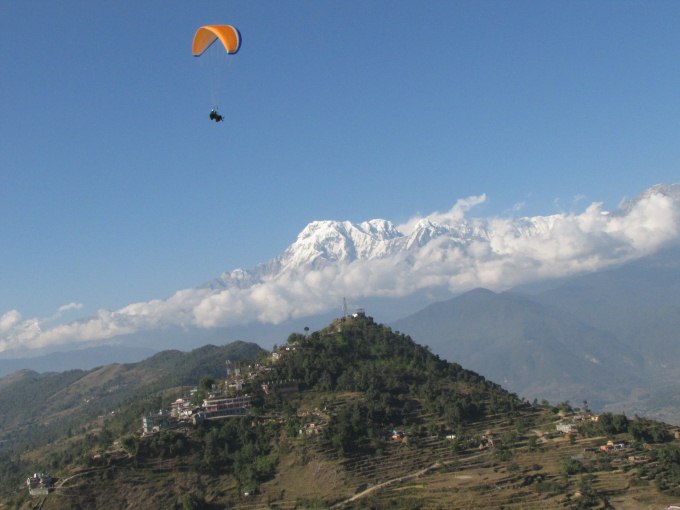
the view from M's paraglide

Another worthwhile walk for the breathtakking views is the three hour hike up to the World Peace Pagoda which sits on top of a hill on the other side of Phewa Lake.  But talking of breathtaking views, the best views we had of the Pokhara valley were from our paraglides.  Yes, you read that right, we went paragliding for the first time in our lives and can't wait to do it again.  Pokhara is one of the top spots in the world for paragliding as the weather is very consistent from September to about January.  We took off from Sarangkot and after an hour flight we landed by the lakeside.  We soared hight above Sarangkot mountain and the Pokhara valley with the vultures and eagles.  The experience was unforgettable!

For more pictures of Pokhara and our paragliding experience, click HERE (password: relax).

conquering Phewa lake

view from the World Peace Pagoda

the World Peace Pagoda

S flying over Sarangkot

traffic over Pokhara and Phewa lake

flying with the vultures

December 25, 2010

MERRY CHRISTMAS MY FRIENDS!!

Wishing all of our family and friends celebrating today a warm and Merry Christmas from S&M in India.  

image courtesy of My Heritage blog


December 22, 2010

Nepal: Chitwan National Park

Our next stop on our tour of Nepal was Chitwan National Park, which is a World Heritage Listed Park reserve that protects over 932 sq km of sal forest, water marshes and grassland. The park boasts 50 different species of mammals including rhinos, royal Bengali tigers, deer, monkeys, wild elephants, leopards, sloth bears and wild boars, as well as 500 different species of birds and butterflies. The one-horned rhinoceros is the most famous animal in Chitwan and one that you are likely to see. The tiger, on the other hand, is a rare sight as there are only 100 or so in Chitwan and they are nocturnal animals.

Before we get into the details of our jungle adventure we must tell you a bit about our bus ride to the park and the bus system in Nepal in general.  The only way to get around the country economically is by bus. Buses reach as far up the mountains as conditions will allow and have a very interesting organization system. Though they aren’t the newest and at times not the most comfortable for tall people, they sure are efficient and an adventure! All the buses (and trucks) are made by Tata, an Indian conglomerate, and we’d say 98% of them are pimped out with designs and murals on the outside and sometimes inside by the cabin. Pretty funky to look at. The insides vary in states of disrepair, with the local buses having the most wear and tear, but they still get you to your destination. We can see why they would be in those conditions due to the state of Nepali roads: either lots of dust and dirt or lots and lots of rocks. Let us tell you a bit about how the buses works. There is always a young boy working the door of the bus. The boy has many jobs from taking all the payments to helping the driver navigate the roads and traffic to soliciting passengers. So what this young boy does is he hangs out the bus door as the bus drives along and yells to the people on the side of the road the buses destination. If someone indicates they want to get on, he bangs once on the side of the bus and the driver stops. Once that person is on (and the luggage has been thrown on the roof) the boys whistles or bangs twice on the side of the bus and the driver takes off and the boy collects the money. This continues throughout the journey. Likewise when someone wants to get off, the boy bangs once to stop the bus, grabs the luggage off the roof, hits the bus twice or whistles to start it up again and then runs to get back on the bus. The boy also removes obstacles from the road and is the driver’s left side mirror when navigating through heavy traffic or narrow streets - he bangs in successive double taps to let the driver know that he has space to pass. Note that all of running, climbing and jumping on and off the bus is performed in flip flops J .

Now a little about the ride itself. Besides being highly entertaining and at times scary (overtaking trucks on blind corners on the side of the mountains in single lane roads) the bus is made for much much shorter people and the windows and doors rarely stay shut. On our ride to Chitwan, every five minutes M would shut the window in front of us leading to the cabin and the window next to us as it was quite cold and we wanted to keep the dust out. It was so dusty that the trees and bushes lining the road were grey rather than green (see picture here: sad grey trees ) and shockingly, villages were drying their laundry along the side of the road. The windows weren’t the only thing sliding open throughout the ride. As we bumped along, the door latch would slowly start to turn and eventually the door would swing completely open. We would ride with the door open (and S&M giggling) until the boy would notice and latch it again. Simply priceless.

water buffalo in the fields of Sauraha
So we finally arrived to Sauraha which is a small village in the parks buffer zone. The first thing that is noticeable as you step off the bus is the clean fresh air and peacefulness of the place. Coming from Kathmandu which was very noisy and polluted this was a welcome change. The area of the village is surrounded by yellow flower fields and native mud huts (houses of the Tharo people). There are elephants and water buffalos everywhere. The first thing we did upon arriving at our hotel was take a long overdue shower. Due to the water shortages and consistent power outages that are more than common in Nepal’s winter months we were unable to shower for the last four days we were in the Kathmandu Valley (note: two of the four days were spent hiking the Himalayas). Yup we are your typical North American prima donnas J .

We spent a total of 3 days and 2 nights at hotel Parkland in Sauraha. They had our whole itinerary planned out for us from the time we woke up to the time we went to bed. This was probably our least favorite part as we both like to explore and do things on our own time … but when in Rome (or in this case Chitwan) do as they do (or say!). Our action packed days included a few nature hikes through the jungle, a beautiful sunset buy the river, a canoe ride down the river (this is where we got our first look at the crocodiles that are quite common along the river side), a visit to the elephant breeding centre and an elephant back safari. All in all we saw and experienced a whole lot. The highlight of the visit was definitely the elephant back safari into and through thick jungle. What magnificent animals. For such a large and powerful mammals it’s amazing how gentle they can be. We both fell in love. While we are on the topic of elephants we also got to visit with a local elephant on our first night in Chitwan. We sat next to him while he was being fed “Kuchi” which are bundles of grasses filled with rice, molasses and salt, while our guide Hari told us all about the captive elephants as well as the difference between Asian and African elephants. We can’t remember them all but one of the differences is the ears with the African elephant having the big ears shaped like Africa (i.e. Dumbo) where as the Asian elephant has small ears shaped like India.

We saw so many animals that one can only see when visiting a zoo in most parts of the world. On our first day we saw two one horned rhinos grazing by the side of the river. During our forays into the jungle we saw many crocodiles, spotted deer, brown deer, monkeys, water buffalos, peacocks, many different birds including storks, wild boars and the ever dangerous wild chicken! What a great experience!!!


As always, here are a few pictures with many more HERE (password: elephant).

cute young female elephant


school children on a sunset canoe trip
  
one horned rhinocerous
 
inside Chitwan National Park
 
ending our elephant safari
 
scenery on our canoe cruise

December 18, 2010

Nepal: The Kathmandu Valley

Here we are starting our fourth moon of honey and about to land on our fourth continent (we're counting Dubai as an American state). Time sure does go by fast when you're unemployed and travelling!  Flying into Nepal was amazing. We first hovered above the clouds with the peaks of the Himalayas breaking through… it was simply breathtaking. Then we turbulently flew into the Kathmandu valley past all of the tiered farmland and safely landed at the Kathmandu airport.

Traffic at Tahiti Tole
The drive towards our guesthouse gave us a good glimpse of Kathmandu: poor, dirty, lots of garbage, run down, alive, bustling, and crazy traffic with lots of trucks, buses, cars and motorcycles all honking at the same time. What to us seemed like complete chaos and gridlock to our driver was "not bad at all". He told us that on some days it takes 3 hrs to complete the 6 km drive. The thing that we can’t help but be shocked at is the style (if we can call it that) of driving by the Nepalese. The fact that there are no road rules makes things a bit interesting to say the least. The lack of these rules becomes quickly clear to us as we continuously watch our driver passing slower vehicles over the sidewalk … and people going around US as we are doing this. Add no traffic lights or signs and horrific road conditions and you have pure insanity! However, astonishingly, amidst all this insanity and continuous honking (by anyone that has a horn) everyone is pretty calm, some would even say Zen. As a side note, we were surprised at how many nice speed bikes there were on the roads (note: the vehicle population in Nepal is ten motorbikes to one car). They were pretty pimped out speed bikes compared to the crappy mopeds that were all over Morocco. We were told that it isn’t that difficult to get a bank loan to lease to own a bike, which costs about $1500 - $2000. Not bad for the quality bikes people had. Add high fuel prices to that equation and everyone and their dog has a motorbike.


Thamel, Kathmandu
We stayed just outside of Thamel which is Kathmandu’s largest backpacker and tourist area. For anyone that has been to Bangkok this is an entire neighborhood that looks like Koh San Road. It is littered with hotels, restaurants, shops, trekking agencies, rickshaw’s and tiger balm salesman. Here you can find the best of fake North Face apparel money can buy or any pirated DVD Hollywood movie that hasn’t even reached the theaters in North America. Then there are hundreds of stores selling Nepali clothes, yak wool or pashmina products. Its great, salespeople are constantly offering you “cheap price” as you’re walking by. But that’s not all that Kathmandu is about. As soon as you get out of Thamel and step inside old Kathmandu you can find countless gems scattered throughout the city. There are temples and shrines that are hidden around every other corner. Some dating back to the 5th or 6th century like the standing Buddha statue that stands 60 cm high along a nondescript wall under a ‘Raj dental sign’. Random and priceless.


Buddha Statue (from 5th or 6th century)
Religion is said to be the cornerstone of Nepali life and it becomes obvious to anyone walking around the country. The two dominant faiths in Nepal are the Hindu religion and Buddhist faith with very little tension between the two - Hindus and Buddhist often worship at the same temples. Throughout the valley there are countless temples and shrines just waiting to be discovered, particularly in Kathmandu and the UNESCO World Heritage listed towns of Patan and Bhaktapur. On the walk down the backstreets of the old town in Kathmandu you are constantly stumbling upon centuries old temples, shrines and statutes. It is quite amazing. In the Kathmandu Valley the following seven monuments within a 20 km radius are considered the Kathmandu Valley World Heritage Site: the historical palaces in Durbar Square in each of Kathmandu, Patan and Bhaktapur, the Buddhist stupas at Swayambhunath and Bauddhanath and two Hindu Temples of Pashupatinath and Changu Narayan. We saw 6 of these 7 sites. We will tell you a little bit about the Durbar Squares of the three medieval cities. Durbar means ‘palace’ and so the square is from where the kings ruled. Each square is filled with spectacular traditional architecture and an assortment of temples. Nepal’s only living goddess, Kumari Devi, is a young girl (who we were lucky to see) who lives in a building known as the Kumari Bahal beside Kathmandu’s Durbar Square. Note: children beware of the erotic art on some of the temples. We could write pages and pages on all of the magnificent sights but we will let you look at the pictures and you’ll hopefully decided to go and see them all for yourself.


Patan's Durbar Square
Before we sign off, we want to tell you a little about Nepal and life for the Nepalese. A large portion of the country is mountains and valleys with the country’s elevation ranging from 60 m above sea level to Mt. Everest (the highest point on Earth) at 8,848 m tall, all within 150 sq km’s. It is really a superbly beautiful landscape. Nepal has 101 ethnic groups (which makes for some really beautiful people … inside and out) and 92 spoken languages. Nepali is the national language of Nepal. We were told that its possible to have two villages right next to each other speaking different languages.

Day to day life in Nepal can be very trying for the Nepalese and an adventure for the visitor. In addition to the traffic issue we discussed above one also needs to get used to rolling power cuts throughout the day, which can range from eight to sixteen hours per day (tip: when booking a hotel ensure that your hotel has a generator or battery and that you get a room far away from the generator!).  As well, the shortage of water (esp. hot) can be nuisance. Considering these and other hardships that the Nepali people live through on a daily basis it’s absolutely inspiring that their spirits are always high. The Nepalese people are really good people; so calm, warm and hospitable.
 
As always, here are a few pictures from our week in the Kathmandu Valley.  For many more pictures please click on this link (password: pollution):  http://s912.photobucket.com/albums/ac322/sandymilos/Nepal_Kathmandu%20Valley/


Pottery being hand made in Bhaktapur
 
 Bhaktapur
 
Typical electricity pole in Kathmandu
  
Seto (White) Machhendranath Temple, Kathmandu
 
A regular market in Kathmandu

Kathmandu

A Sadhu (wandering holy man) in Nepal


Our view of Kathmandu from Swayambhunath (aka "Monkey Temple")


December 12, 2010

Dubai: America’s 51st State


a view from the subway car
 We can only give you our first impression of Dubai as we spent a short amount of time there but here it goes.  As our title says Dubai should be Americas 51st desert state. It’s pretty much a concrete jungle in the middle of the desert which caters to very rich people or those who pretend to be rich. Everything in Dubai is big, and we mean BIG! It’s a city full of malls, residential and office skyscrapers, a lot of hotels AND lots and lots and lots of construction. While the architecture is very interesting (predominantly glass) the city is just a lot of buildings clumped together seemingly along the subway line. There is really no style or design to the city. Don’t get us wrong, the individual buildings are very intricate in design and impressive, however, when you clump them all together their uniqueness tends to get lost.

We spent a lot of time in the Mall of the Emirates that was located close to our place as it was the center of the community: where the subway, groceries and the majority of the restaurants were. We should mention that this same mall houses the infamous ski Dubai complex. For those of you that are not familiar with this facility it is the first and only ski hill in the world located in the middle of the desert. Not to mention damn funny. Imagine a bunny hill, now add walls and a ceiling and a big glass viewing gallery that looks into the mall and you have Ski Dubai. Oh yeah we forgot to mention that there’s a chalet at the bottom of the slope that has a t.v fireplace to add to the ambiance. Awesome. The rest of the mall is very grand with ALL of the top designers (Leboutin, Dior, Gucci, Prada, etc) and of course, three H&M stores. Let’s not forget the chandeliers and elegant staircases to take around this massive complex.


Ski Dubai
The highlight of our stay in Dubai, besides laughing our asses off with Captain P, was going to the beach. The weather was a perfect 30 degrees (of course Celsius, it’s the only measure that makes sense), not a cloud in the sky and fine sand under our feet. The whole experience was amazing.

Again, as with Morocco, one of our concerns coming to Dubai was how S should dress. We quickly realized that Dubai is mostly foreigners with a few UAE nationals sprinkled throughout and being Americas 51st state, anything seems to go. The only way you know you’re not in the States is due to the UAE nationals walking about in their robes: men all in white with a withe head scarf and black band holding it in place and the women in a black robe and full burqa. Again, more unfairness to the women, making them wear all black in the desert heat!! We note that this dress is in contrast to Morocco where the women wore all white as we got to the beach and desert towns. While we are comparing Dubai to Morocco, we wanted to note that there was a difference in the daily call to prayer. In Dubai, the call was much more beautiful, like a soft and lyrical song … a hymn, where as in Morocco it was more like talking or yelling.

For those of you that have been following us, we talked quite a bit about the medina’s in Morocco, so we were in for a shock when we went to visit the medina in Dubai. S, being a little naïve was so excited to finally see some culture and an old medina and was she in for a surprise. Lo and behold, this medina was nothing more than a multi billion dollar complex of stores, pimped out hotels and restaurants surrounded by fancy medina walls. For what it was, they really pimped it out proper.
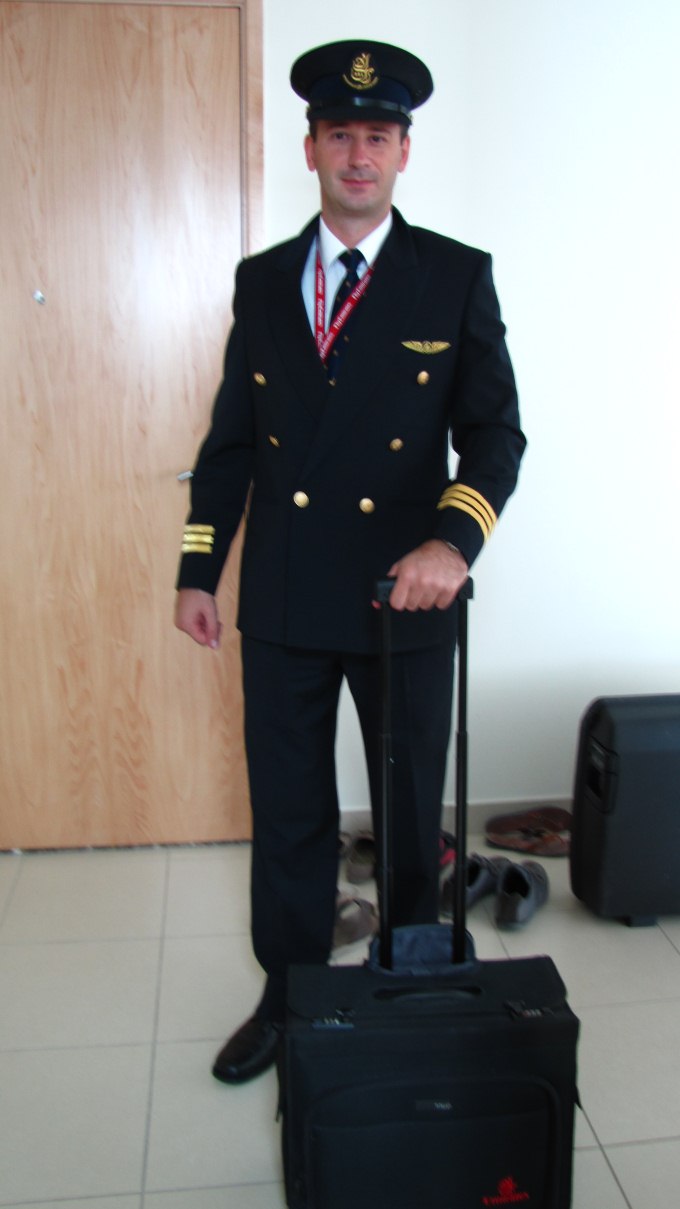
Before we move on to speak about our amazing flight to our next destination (it’s a secret but as a hint … we’ve moved on to Asia), we must take a few moments to tell you about our amazing host, Captain P. Yes, he really is a captain flying Boing 777’s for Emirates and ladies he is still available. He made our stay top notch, with a big welcome dinner (including kangaroo meat!!!), a pimp pad to call home with a projector TV (yes, we spent one full day watching movies and lying on the couch J ) and a trip to the beach. Captain P, thank you so much, puno te volimo and may the skies be friendly!  

While we are on the topic of flying we wanted to end this post with a HUGE thumbs up to Qatar Airlines. Talk about 5 star service in economy class J . We had exit row seats on both of our flights which we didn’t have to pay more for. Now this was not your standard exit row seat where you gain a few centimeters in leg room. We kid you not we had 3 meters of leg room all to ourselves. Add a personal entertainment system with a remote control (and Tetris!), great meals AND a hot towel to refresh yourself and you have very enjoyable flights! So a little rant about hot towels and their disappearance from flights: is it that expensive to have hot hand towels on every flight in North America? You can wash the damn things and use the microwave to get them hot. COME ON PEOPLE this is not too much to ask if you are paying hundreds of dollars to fly. We can sort of see how a $4 meal would break an airlines budget (SARCASM!!!) but there is no excuse to take away our hot towels. We are not animals damn it!!! Ahhhh that felt good, almost as good as when you run a hot towel across your face during a long flight J.
Follow this link for more pictures of Dubai (password: 51st): http://s912.photobucket.com/albums/ac322/sandymilos/dubai_2010/

Worlds tallest building

Dubai financial district

The beach


Dubai's bidet and toilet

Our amazing leg room and entertainment

Ski Dubai from inside the mall

Mall of the Emirates

December 10, 2010

Food in Our 3rd Moon


Mint tea
I’m sure this post comes as no surprise to those that have followed us thus far. Food is one of our biggest passions so we will be keeping this up as we go along. In our third moon we had the pleasure of eating our way through Morocco. The staples in Morocco are things made from dough (bread, flat bread, various types of pancake like things, etc), olives, dates and dried fruit, couscous, tajine (made from root vegetables and various meats excluding pork), La Vache Qui Rit and Kiri cheese, argan oil and let’s not forget mint tea. Mint tea is the cornerstone of Moroccan society: it is not just a beverage it’s a way of life in Morocco. It ends every meal and all socializing and business is conducted over mint tea. The service itself is a ceremony. The tea arrives in small metal pot filled with fresh mint and hot water accompanied by a large block of sugar. Before you drink the tea the host will take most of the sugar and crumble it into the pot. Then the ceremonial pouring and repouring of the tea begins. The tea is poured into one of the small glass glasses and this is not just any pour, the pot is tilted and is gradually raised above the glass to a couple of feet as the liquid slowly fills the glass. The liquid is then poured back into the metal pot. Seeing the pride in the eyes of the pourer as they go higher and higher with the pot is absolutely pricess. These two steps are repeated quite a few times before the tea is finally poured for drinking. The end result is a very sweet warm minty beverage. 


Super greasy and super tasty breakfast
Next is breakfast. Breakfast on the go Moroccan style almost always involves either a Moroccan pancake or a deep fried dough. A Moroccan pancake or ‘Rghaif’ is a flaky yet dense dough which when fried resembles something like a flattened croissant - pancake hybrid. You can have it plain or as we saw it, with argan oil and/or honey in the south, or with cheese and honey in the north. All absolutely delicious. There is also a much larger version which we think is called a ‘Beghrir’. The super greasy deep fried dough that is the heavier deadlier breakfast can be had with or without an egg fried into it. Let us describe the cooking process with an egg: first the man grabs a ball of dough and flattens it into a hockey puck, this puck is dropped in a huge tub of sizzling cooking oil. After two minutes of bathing in the oil the man grabs the sizzling fried dough with his bare hands rips a hole in the middle, throws it back into the oil and cracks an egg into the hole. After a single flip and about a minute of cooking time the finished product is placed on a single napkin for consumption. Oh God is this greasy heart attack ever worth it. We suggest washing it down with a cup of coffee followed by a bath. In contrast to this street fare, a typical hotel breakfast pretty much always consists of bread, jam, butter, orange juice and coffee. We also had the pleasure of having breakfast with a Berber family in their home. The menu consisted of a Berber porridge (rice, millet and lots of milk), home made Moroccan bread, jam, honey, argan oil and of course mint tea.
Hotel Atlas' tajine kefta kiri (just finger licking good)
Lunch and dinner are pretty much the same, with lunch seeming to be the larger meal. At restaurants, meal. At restaurants, meal. At restaurants, the meal always starts with bread, butter and spiced olives. In the western restaurants and hotels you always get cutlery however Moroccans use the bread as their utensils and always eat only with their right hand.  The main course usually consists of some form of a tajine, kebabs or couscous. Quality and flavor certainly depended on the cook. We had some great food and some pretty bland food. So what is a Tajine you ask? Tajine is a Moroccan stew cooked in a conical earthenware pot that keeps the juices in and the meat tender and moist. They come in all shapes and sizes from a basic vegetable tajine to a meat tajine with vegetables and/or olives and/or lemons and/or cheese. While we are on the topic of tajines we have to say that the best one we had all trip was the tajine kefta kiri at hotel Atlas in Mirleft cooked by the Kadija. This a tajine made with meatballs in a rich tomato sauce with kiri cheese and toped with a sizzling egg. A tajine masterpiece. We hope to have this again… inshallah. The bread that comes with all the meals as a side or utensil is called Khoobz. It’s a Moroccan style pita bread that’s about an inch thick, crusty on the outside and fluffy on the inside.

Snack options in Morocco are the above mentioned pita breads cut in half and stuffed with minced meat and onion. We also came accross the most amazing churros, which were these little deep fried rings of dough sprinkled with sugar. And last but not least you can help yourself to a bowl of snail soup for which you get a hook to pull the snails out. Unfortunately or fortunately we didn’t try the snail soup, but the locals line up for it.

We didn’t always eat out, as we had a kitchen for the first week we had the pleasure of doing our own grocery shopping and cooking. The shopping itself is an experience and a half. You walk down a market street with your choice of fresh produce, spices and grains. If you want a chicken you pick the one behind the guy selling them and he then kills it and cuts it up for you. Talk about fresh, organic and tasty.

One of our many home cooked meals
Couscous Royal (with merguez sausages, chicken, kefta and vegetables) and veggie tajine
Fresh is the name of the game (tyical fresh produce stand)
Organic chicken
Breakfast Morocco style

home cooked Moroccan meal ... simply delicious!!

what a few dollars at the market can get you


breakfast after a trip to the market
 
delicious duck at the birthday dinner

The chefts at a food stall at the square in Marrakech

another fantastic meal by chef Kadija at Hotel Atlas